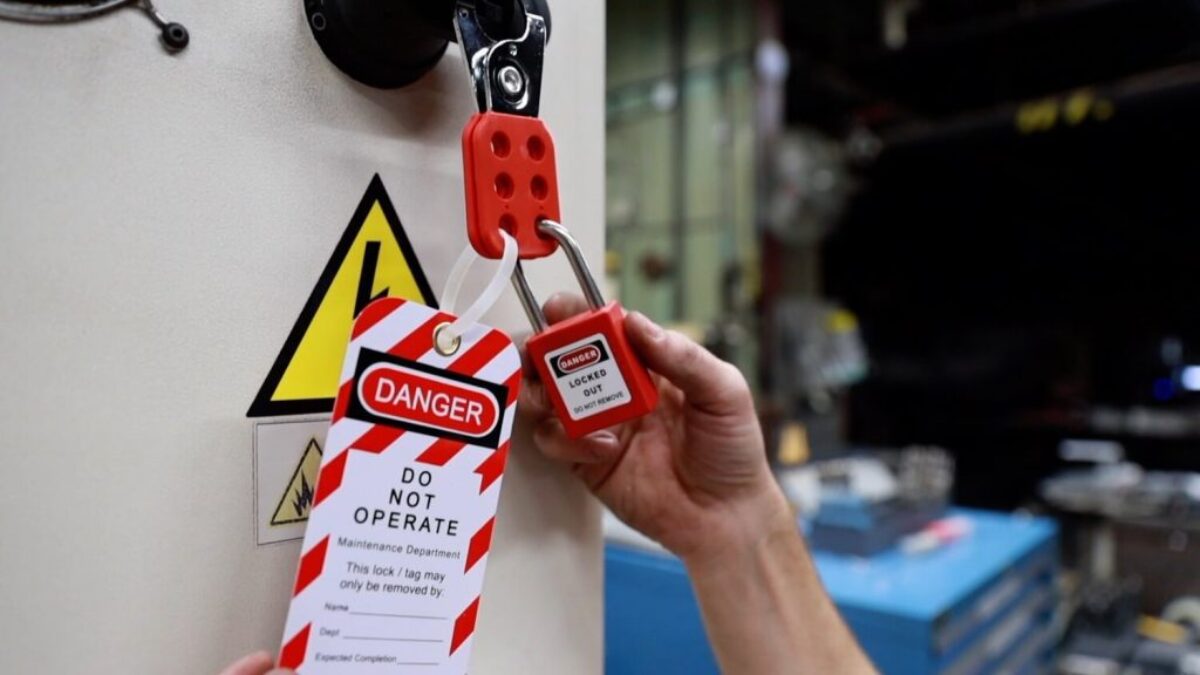
Why Lock Out Tag Out Matters
Every year, serious injuries and fatalities occur during maintenance and servicing because hazardous energy was not fully controlled. Lock Out Tag Out (LOTO) is the proven method to prevent unexpected energization or the release of stored energy from electrical, mechanical, hydraulic, pneumatic, chemical, thermal, or gravitational sources.
Done correctly, LOTO prevents injuries and fatalities by establishing a known, verified zero-energy state, reduces downtime and equipment damage by standardizing safe isolation and start-up, demonstrates due diligence through documented procedures and audits, and strengthens safety culture by clarifying roles and controls. Whether you run a fabrication shop, terminal, plant, mine, utility, or construction project, a robust LOTO program is a foundational control.
What Is LOTO, in Plain Language
Lockout means applying an isolation device (a lockable disconnect, valve lock, or circuit breaker lock) and securing it with a personal lock so the equipment cannot be energized. Tagout means attaching a warning tag identifying the worker who applied the lock, the date and time, the equipment, and the purpose. Tags alone are not a physical control. They must accompany the lock unless your jurisdiction specifically allows tagout-only systems under strict conditions. The goal is to isolate, dissipate, and verify all hazardous energy sources so the equipment cannot move, start, or release energy while people are exposed.
Regulatory and Standards Landscape
In Canada, most provinces and territories adopt requirements for the control of hazardous energy, often aligned with CSA Z460, Control of Hazardous Energy. Alberta OHS legislation, for example, requires employers to identify, assess, and control hazardous energy with written procedures, training, and verification. In the United States, OSHA 29 CFR 1910.147 sets detailed LOTO requirements. If you operate across jurisdictions, harmonize to the strictest standard you face and cross-reference local requirements in your written policy.
Core Elements of a LOTO Program
A complete program includes a written policy setting expectations and accountability, equipment-specific procedures with step-by-step isolation instructions, training and competency verification for authorized and affected workers, durable and standardized locking and tagging hardware, group lockout and complex isolation controls, change management and shift-handover processes, audits and continuous improvement, and contractor management to align third parties to your standard.
Building Your Program from Scratch
1. Establish Your Policy
Your policy sets the rules. It should affirm that no one bypasses LOTO when servicing, maintaining, or clearing jams; define roles (authorized employees apply locks and verify zero energy, affected employees work around equipment and must understand the restrictions, supervisors enforce and document, and contractors follow your rules unless an equivalent standard is pre-approved); set minimum hardware standards; require equipment-specific procedures; and mandate training, competency checks, annual audits, incident reviews, discipline for non-compliance, and stop-work authority.
2. Inventory Assets and Energy Sources
Create an Energy Isolation Register listing each asset's name and location, its energy sources (electrical, hydraulic, pneumatic, thermal, chemical, gravity, springs), its isolation points, its stored-energy dissipation points and methods, any special tools or PPE, its verification methods, and the procedure owner and last review date. This register is the foundation for your procedures and audits.
3. Write Equipment-Specific Procedures
Each procedure should be clear, numbered, and visual, covering purpose and scope, required PPE and tools, authorized persons, shutdown steps, isolation steps (identifying each energy source and the exact device), application of locks and tags (one lock per person), stored-energy control (bleed, block, blank, restrain, discharge, chock, pin), verification of the zero-energy state (try-start, test-for-dead, gauge checks), the work steps, and return to service (each worker removes their own lock, then re-energize and test). Add diagrams or photos marking isolation points. The clarity rule: if an authorized worker cannot perform the steps confidently from the procedure alone, it needs more detail.
4. Define Hardware Standards and Color Coding
Personal locks should be individually keyed, with each worker keeping their own key. Tags must be durable, legible, and dated. Use hasps for multiple workers on one point and group lock boxes to secure master keys, with each worker applying a personal lock to the box. A common color scheme uses red for personal energy-isolation locks, blue for supervisor administrative locks, yellow for out-of-service or defective equipment (not a LOTO device), and green for tightly controlled test or commissioning work. Test valve and breaker lockout devices for compatibility before buying in bulk.
5. Train and Verify Competency
Authorized employees need in-depth training on your policy, equipment procedures, stored-energy hazards, instruments, and verification, with a required practical demonstration. Affected employees need awareness of purpose, scope, and prohibitions (never remove someone else's lock, never operate a locked or tagged device). Supervisors need enforcement, coaching, and documentation skills. Contractors need orientation to your rules and proof of competency. Use scenario-based, hands-on exercises, keep training records, and schedule refreshers at least annually or when conditions change.
6. Manage Group Lockout, Shift Change, and Complex Isolations
For group lockout, a competent person isolates all points, places the master keys in a lock box, and each worker applies a personal lock to the box; no work begins until everyone is locked on. For shift changes, run a formal handover so no device is ever left without a personal lock, with incoming workers locking on before outgoing workers remove theirs. For complex systems with multiple interconnected energy sources, use isolation plans and permits reviewed by a qualified person, supported by P&IDs, line walks, and blind lists.
7. Control Stored and Residual Energy
Even after isolation, energy may remain stored. Bleed hydraulic and pneumatic systems to zero and confirm via gauges; discharge electrical capacitors and confirm absence of voltage with a tested meter; block, pin, chock, or crib gravity and mechanical hazards; allow thermal systems to reach a safe temperature; and neutralize, drain, and blank chemical lines, testing the atmosphere as required. Document the specific methods in each procedure and verify before work begins.
8. Change Management and Reviews
Update procedures when equipment is modified or relocated, protective devices change, an incident or near-miss reveals a gap, regulations change, or new types of work are introduced. Set a formal review cycle (for example, annual) with sign-off from a competent person.
Common Failure Modes, and How to Prevent Them
The recurring failures are a missing energy source (prevent with a thorough energy survey cross-checked against P&IDs and single-line drawings), stored energy that was not dissipated (prevent with explicit stored-energy steps verified by gauges, meters, and physical checks), shared devices serving multiple machines (prevent with clear labeling, procedure diagrams, and the lock-box method), shift-change gaps where locks come off before the next shift locks on (prevent with a formal handover checklist and supervisor oversight), and contractor misalignment where different companies apply different standards (prevent with pre-job alignment, orientation, and a single controlling-employer rule).
Auditing and Continuous Improvement
Run an annual program audit, and audit again after changes or incidents, assessing policy completeness and leadership accountability, training coverage and competency records, the accuracy of equipment procedures (spot-checked in the field), hardware condition, documentation of group lockout and shift changes, and closure of corrective actions. A supervisor field-verification checklist should confirm the procedure is available at the point of use, all energy sources are identified and isolated, each worker has their own personal lock, stored energy is dissipated or blocked, zero energy is verified, the work zone is controlled, and return-to-service steps are followed and documented.
KPIs Worth Tracking
Useful measures include the percentage of authorized employees current on training and their first-attempt practical pass rate, the number of field verifications per month and their conformance rate, the number of procedures reviewed or updated per quarter, the number of energy-control incidents and near-misses with corrective-action closure time, and audit scores across policy, procedures, training, and hardware.
Digital Enablement
Small technology additions have big impact: QR codes on equipment linking to the latest procedure and diagrams, a CMMS that triggers procedure reviews when equipment changes, mobile forms for field verification with photo evidence, and a training system that schedules refreshers and stores competency records.
Frequently Asked Questions
When is LOTO required? Whenever a worker may be exposed to hazardous energy during servicing, maintenance, unjamming, cleaning, or adjustment where unexpected start-up or energy release could occur. Routine operations with effective guarding may be exempt, but if guards are removed or bypassed, LOTO applies.
Can one lock represent a crew? No. Every exposed worker applies their own personal lock. That is the heart of LOTO: each person controls their own safety.
What about contractors? Contractors must follow your LOTO program, or a documented equivalent that you have approved in advance, and be oriented to your specific procedures before work begins.
Build It Right, and Build the Culture
A LOTO program is only as strong as the discipline behind it. The policy, procedures, hardware, and audits matter, but the culture (where every worker locks on, no one bypasses the process, and stopping work is always acceptable) is what actually keeps people alive. If you need help building a compliant LOTO program, writing equipment-specific procedures, or training your team, TruStar Safety can help.