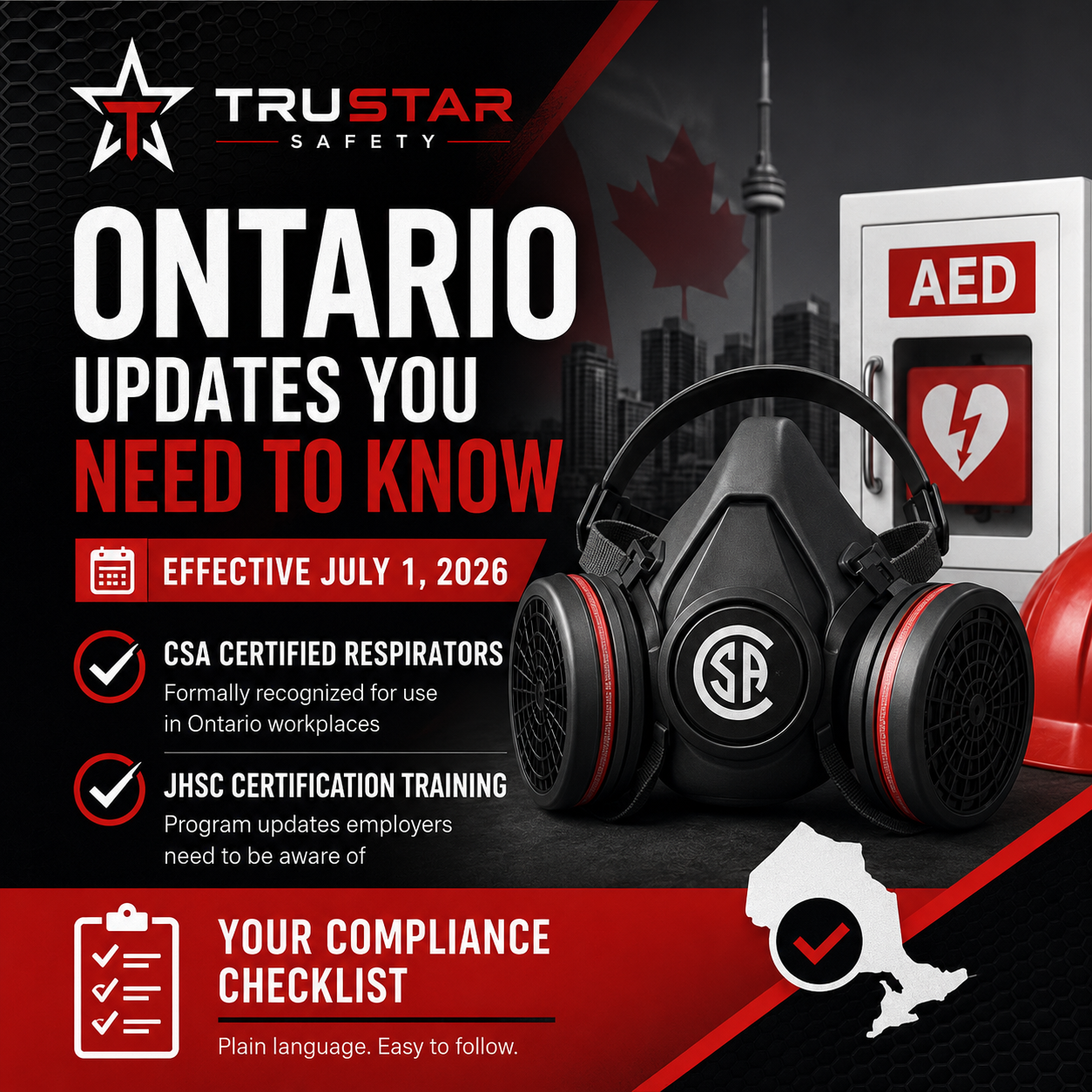
Ontario employers have a busy compliance year ahead. Two notable changes land on July 1, 2026 (formal recognition of CSA Group certified respirators and an updated Joint Health and Safety Committee Certification Training Program), and they arrive on top of changes that already took effect January 1. Here is what shifts, who it affects, and what to put on your action list now.
What changes on July 1, 2026
1. CSA Group certified respirators are formally recognized. Amendments to Ontario's OHSA regulations recognize respirators certified by CSA Group, in addition to the certifications employers have relied on for years. In practical terms, that widens the pool of acceptable respiratory protection you can specify, purchase, and document.
2. The JHSC Certification Training Program is updated. The biggest structural change is a simplified path back to good standing. Certified members whose certification has expired will be able to take Refresher training rather than repeating Part One and Part Two from scratch. Program content is also being strengthened in areas that reflect real-world claim and complaint trends, including workplace violence and harassment and occupational illness.
If your certification tracking spreadsheet has been quietly accumulating "expired" entries, July 1 is your opportunity to bring people back into compliance without starting over.
Two changes that already took effect January 1, 2026
If you have not caught up on these, do it before July.
AEDs on larger construction projects. Mandatory automated external defibrillators are now required on construction projects with 20 or more workers that are expected to last three months or longer. Sites in scope must also have at least one worker on site trained in CPR and AED use.
A new penalty landscape. Ontario's Administrative Monetary Penalty (AMP) regime under Part IX.1 of the OHSA, introduced through the Working for Workers Seven Act, 2025, allows inspectors to issue financial penalties directly rather than routing every matter through prosecution. Maximum OHSA fines have also increased substantially, with directors and officers facing up to $1,500,000 per offence and/or up to 12 months imprisonment, and other persons facing up to $500,000 per offence. Repeat corporate offences involving death or serious injury within a two-year window carry a minimum fine of $500,000.
The practical takeaway is not panic. It is that the cost of an unresolved, well-documented deficiency has gone up, and the time between an inspector's visit and a financial consequence has gone down.
Your July 1 compliance checklist
Respiratory protection:
- Review your respiratory protection program and update the language describing acceptable certifications to reflect CSA Group recognition.
- Confirm what your crews are actually wearing, and that each model is certified and appropriate for the assessed hazard.
- Recheck fit testing records, cartridge and filter change schedules, storage, inspection, and cleaning procedures.
- Retrain workers if you introduce new models. A different respirator can mean a different donning sequence, seal check, and fit test result.
JHSC certification:
- Pull a current list of every certified member, their certification dates, and which sites they cover.
- Flag anyone expired or expiring in the next 12 months and book Refresher training once it is available.
- Confirm you still meet the committee composition and certified-member requirements for each workplace as headcounts change.
- Make sure new content on workplace violence, harassment, and occupational illness flows into your committee's agenda, inspections, and recommendations, not just into a certificate.
Construction AED readiness:
- Identify which of your projects cross the 20-worker and three-month thresholds, including projects that grow into scope mid-build.
- Document AED location, signage, monthly inspection, pad and battery expiry dates, and who is trained.
- Fold AED use into your emergency response plan and rehearse it. A device nobody can find in 90 seconds is not a control.
Governance:
- Brief your directors, officers, and site leadership on the AMP regime and the increased maximum fines.
- Review how you close out inspector orders and internal corrective actions, including who owns each item and how completion is verified.
Don't lose sight of heat
Summer regulation reading has a way of crowding out the hazard that is already outside. Extreme heat is a growing workplace concern across Canada. During one mid-July heat wave, humidex readings reached 45°C across parts of southern Ontario and western Quebec. Research from Quebec and the United States has linked higher temperatures to higher injury rates, in part because heat impairs cognition, reaction time, and balance. That affects indoor workers in poorly ventilated spaces as much as it affects roofers and pipeliners.
Practical steps that hold up well:
- Acclimatize new and returning workers over the first several shifts.
- Build in shade, water, and scheduled rest, and schedule the heaviest tasks for cooler hours.
- Train supervisors and workers to recognize heat illness in themselves and each other.
- Use a buddy system and a clear escalation path for anyone showing symptoms.
What else is worth watching
Regulatory change is not limited to Ontario. If you operate in multiple provinces, keep an eye on:
- Provincial OHS code and regulation reviews in your operating jurisdictions, and any consultation periods where employer input is invited.
- WCB and workers' compensation board rate, premium, and reporting changes for the coming year.
- COR and SECOR audit protocol updates from your certifying partner, which often shift required documentation before anything in legislation changes.
- Product and equipment safety alerts and recalls affecting fall protection, respirators, gas detection, and lifting gear.
A simple habit helps here: assign one person to check your applicable regulator and certifying-partner bulletins monthly, and bring anything relevant to the next JHSC meeting. Fifteen minutes a month beats a scramble after an order.
Turning updates into a program
Most compliance failures are not about intent. They are about documents that describe an older version of your workplace. A good rule of thumb: whenever legislation changes, ask whether your written program, your training records, your field practice, and your verification all still agree. If any one of the four drifts, an inspector will find the gap before you do.
If you would like help updating your respiratory protection program, refreshing JHSC training, arranging CPR and AED training for construction crews, or preparing for a COR or SECOR audit, TruStar Safety can help. Reach out and we will walk through your sites, your paperwork, and what needs to change before July 1.