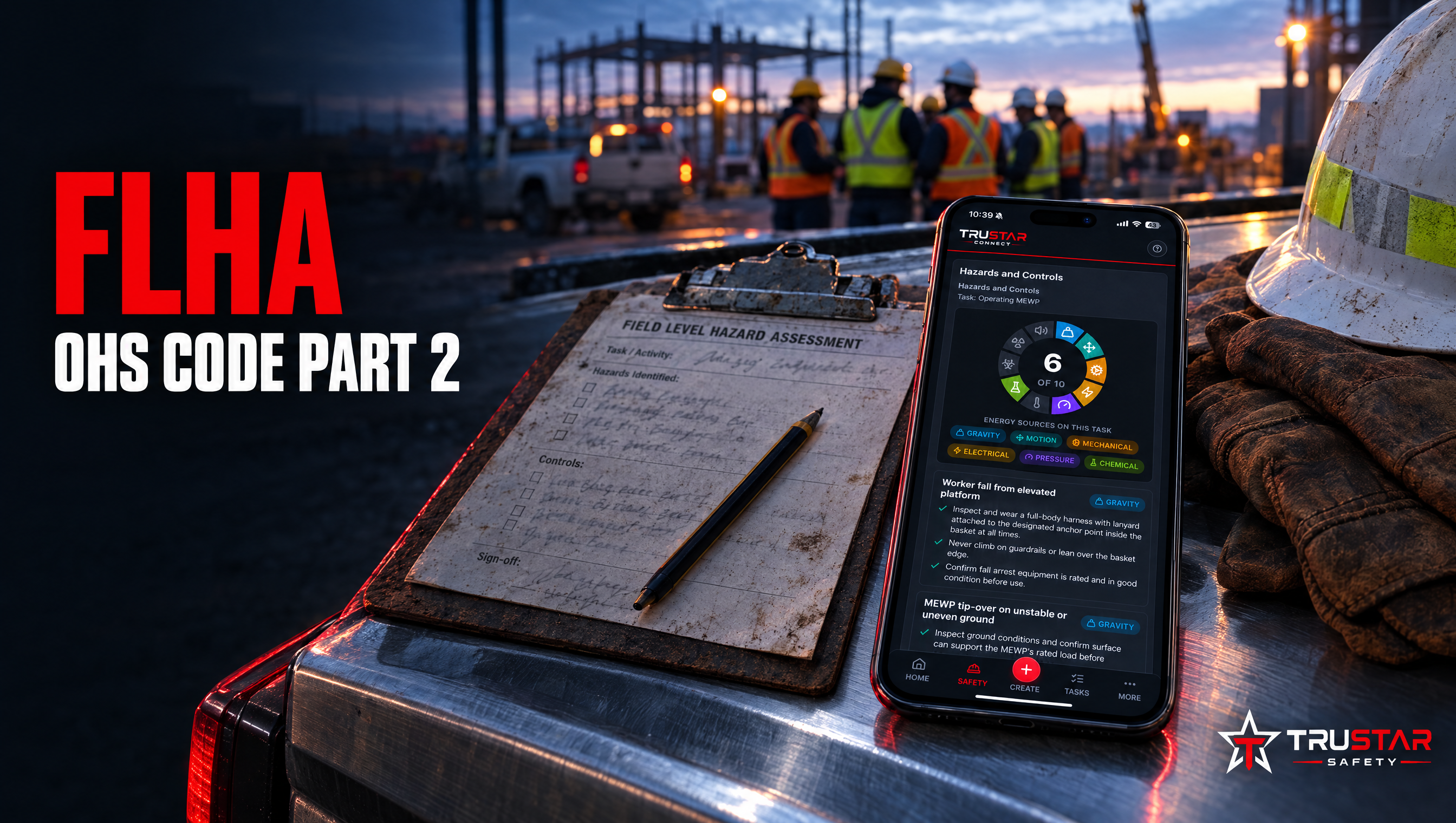
A field level hazard assessment (FLHA) in Alberta is the written, on-the-spot check a crew completes before a task starts, listing the hazards at that location and how each one will be eliminated or controlled. The OHS Code does not use the term "FLHA", but Part 2 requires employers to assess the work site before work begins, put the results and controls in writing, involve affected workers and repeat the assessment when work changes, and the FLHA is the tool Alberta sites commonly use to meet that duty at the task level.
It is one of the most-used safety documents on an Alberta job site, and one of the first places an auditor looks. Here is what the law says, how an FLHA fits beside your formal hazard assessment, and the mistakes that turn it into a paper exercise.
What OHS Code Part 2 requires for hazard assessment
Hazard assessment lives in Part 2 of the Alberta OHS Code, Hazard Assessment, Elimination and Control. Four sections do most of the work.
Section 7: assess before work begins and write it down
Section 7(1) requires an employer to assess a work site and identify existing and potential hazards before work begins at the work site, or before construction of a new work site starts. Section 7(2) requires a report of the results of the hazard assessment and the methods used to control or eliminate the hazards identified.
Alberta's Hazard Assessment and Control handbook is plain about the practical meaning: the report must be in writing and readily available for reference at the affected work site. A card locked in the supervisor's truck across the lease, or filed at head office, does not do that job.
Section 7(3) requires the date the hazard assessment is prepared or revised to be recorded on it. An undated FLHA cannot show that the assessment happened before the work did.
When a hazard assessment must be repeated
Section 7(4) requires the hazard assessment to be repeated:
- At reasonably practicable intervals, to prevent unsafe and unhealthy working conditions from developing.
- When a new work process is introduced.
- When a work process or operation changes.
- Before the construction of significant additions or alterations to a work site.
Alberta's Part 2 explanation guide adds that assessments should be done periodically even when nothing has changed, to confirm workers are still following procedures and equipment is still in good condition.
Section 8: worker participation
Section 8(1) states that an employer must involve affected workers in the hazard assessment and in the control or elimination of the hazards identified. Section 8(2) requires that workers affected by the hazards in a hazard assessment report are informed of those hazards and of the methods used to control or eliminate them.
In FLHA terms, the people doing the task help identify the hazards, and every exposed worker knows the controls before work starts.
Section 9: the hierarchy of controls
Section 9 sets the order in which hazards must be dealt with once they are identified:
- Eliminate the hazard.
- If elimination is not reasonably practicable, use engineering controls.
- If the hazard still cannot be eliminated or controlled, use administrative controls that bring it to a level as low as reasonably achievable.
- If it still cannot be eliminated or controlled, ensure workers use the appropriate personal protective equipment.
A combination of engineering controls, administrative controls and PPE may be used where it gives a greater level of worker safety. The practical test for an FLHA: if the only control written beside every hazard is "PPE" or "be careful", the crew has skipped the first three steps.
Section 10: the emergency exception
Section 10(2) says that sections 7(2) and 7(3) do not apply to an emergency response during the period that emergency action is required. Section 10(1) still limits exposure to workers competent to correct the condition, keeps their number to the minimum necessary and requires every reasonable effort to control the hazard in the meantime. Once the emergency is over, the normal written assessment rules apply again.
Formal vs field level hazard assessment
Alberta's guidance describes two layers that work together.
The formal hazard assessment
Alberta's handbook explains that when the legislation refers to hazard assessments, it means a formal hazard assessment: a close look at the organization's overall operations, with jobs broken into tasks, hazards identified for each task and controls developed, implemented and monitored. It takes time, involves more people (including the health and safety committee or representative, where there is one) and is reviewed as the operation changes.
The field level (site-specific) hazard assessment
The handbook describes the site-specific or field-level hazard assessment as the tool for hazards that show up because of changing circumstances at a work site. The Part 2 explanation guide notes that at locations where activities and conditions change often, such as construction, road building, brush control and outdoor work affected by weather, employers and workers rely on FLHAs done on the spot at the start of the work day or when a new job starts.
How they fit together
Think of the formal assessment as the library and the FLHA as today's page. The formal assessment says, for example, that working at heights requires a fall protection plan and a specific anchor system. The FLHA confirms that today, on this roof, in this wind, with this crew, those controls are in place, and catches what the formal assessment could not predict: the trade working overhead, the ice on the ladder, the buried line that was not on the drawing.
If FLHAs keep flagging the same hazard, it belongs in the formal assessment with a proper control.
What a good FLHA form captures
The explanation guide shows a sample FLHA form from the Construction Owners Association of Alberta. You do not need that exact layout, but a defensible FLHA form usually captures:
- Date, time and task location, plus the permit or job number where one applies.
- The work to be done, broken into steps, not just "general labour".
- Hazards for each step, including hazards from the surroundings: moving equipment, overhead work, stored materials, weather, adjacent trades.
- Controls for each hazard, matched to it and following the hierarchy of controls.
- The emergency muster point and any working alone arrangements.
- Names and signatures of every crew member before work starts.
- A supervisor review signature, from someone who actually read it.
- A revision section for when conditions or tasks change mid-shift.
- A close-out: permits closed, area cleaned up, incidents reported, hazards remaining.
Common FLHA failures auditors find
These patterns show up again and again in hazard assessment reviews and COR or SECOR audits.
Pencil-whipped cards
Identical cards day after day, same hazards, same controls, ticked in thirty seconds. A copied card proves a form was filled in, not that anyone looked at the site. Ask the crew what is different about today before anyone writes.
Controls that do not match the hazards
"Struck by equipment: wear hard hat." "Excavation collapse: be aware." The control has to actually reduce the risk from that specific hazard, and it should reflect the hierarchy. Spotters, exclusion zones, shoring, lockout and task sequencing are controls; "be careful" is not.
Done after the work started
Section 7(1) says before work begins. Cards completed at coffee break or signed at the end of the shift, or with no time recorded, cannot show that.
Never revised when conditions change
The weather turns, a new trade shows up, the scope changes, and the morning card stays in the truck. Section 7(4) is clear that a change in the work process calls for a new assessment. Build a revision block into the form and train supervisors to use it.
Signatures without participation
A full row of signatures from workers who were never asked a question does not demonstrate the involvement section 8 requires. Good FLHAs are a two-minute crew conversation that happens to be written down.
Cards nobody can find
The card exists somewhere, but when an auditor or OHS officer asks for last Tuesday's FLHA for the north tie-in, nobody can produce it. If you cannot retrieve it, it is hard to prove it happened.
How to make FLHAs work on your sites
- Link the FLHA to your formal hazard assessment, so crews know which task controls are already set and what they are checking for today.
- Train supervisors to lead the conversation, not fill in the form. Coach them to ask open questions: what is different today, what could hurt us, what would we do if it did.
- Review cards for quality, not just completion. Pull a sample each week and check that controls match hazards and follow the hierarchy.
- Make revision normal. A revised card is a sign the process is working.
- Keep records retrievable, organized by date, site and task, so you can answer an auditor in minutes.
Frequently asked questions
Is a field level hazard assessment required by law in Alberta?
The OHS Code does not use the term "field level hazard assessment". It does require employers to assess the work site and identify existing and potential hazards before work begins, prepare a written report of the results and controls, and repeat the assessment when work processes change (OHS Code Part 2, sections 7 and 8). On sites where conditions change daily, a completed FLHA is a widely used way for employers to show they have met those requirements at the task level.
How often do you need to do an FLHA?
Alberta's guidance describes FLHAs being done at the start of the work day or when a new job starts. Section 7(4) also requires the assessment to be repeated when a new work process is introduced or a work process or operation changes, so an FLHA should be revised whenever the task, the crew, the equipment or site conditions change during the shift.
Who should fill out the FLHA?
The employer is responsible for the hazard assessment, but section 8 requires affected workers to be involved in it. In practice the crew doing the task completes the FLHA together, led by a supervisor or lead hand, and every exposed worker signs it before starting.
What is the difference between a formal hazard assessment and an FLHA?
A formal hazard assessment reviews the whole operation job by job and task by task and sets the standard controls. An FLHA applies that thinking to one task, at one location, on one day, and picks up hazards created by changing conditions.
Can a digital FLHA replace paper cards in Alberta?
Part 2 requires the report to be written and dated, and Alberta's guidance says it must be readily available at the affected work site. It does not require paper. A digital FLHA that workers can open on site, that records the date and the crew's sign-off, and that can be retrieved later can serve the same purpose, provided workers can actually access it where they are working. Check any owner or prime contractor requirements on format too.
How TruStar can help
TruStar Safety helps Alberta employers build hazard assessment programs that hold up in the field and at audit time. We develop and update formal hazard assessments, design FLHA forms that fit your work, train supervisors to lead real hazard conversations, and review your records against OHS Code Part 2 and COR and SECOR expectations. If you need ongoing support, a fractional safety manager can keep the program running between audits. Talk to us about your hazard assessment program.
If paper cards are your weak point, TruStar Connect moves them onto the phone your crew already carries. Its Hazard Assessment screen replaces the paper card, timestamps every assessment and keeps them retrievable, so the card from last Tuesday is there when the auditor asks. Start a free trial and see how your crews take to it.