To get a COR in Alberta, you build a health and safety management system that meets provincial standards, choose a Certifying Partner, and pass an audit with at least 80% overall and at least 50% in every element. Your Certifying Partner then co-signs the certificate with the Government of Alberta, and you keep it with two maintenance audits before recertifying in year three.
Below is each step as it plays out for Alberta employers: who does what, what the auditor checks, and what it means for your WCB premiums.
What a COR is and why Alberta employers go after one
A Certificate of Recognition (COR) shows that a certified auditor has evaluated your health and safety management system and found it meets Alberta's provincial standards. It is issued through Partnerships in Injury Reduction (PIR), a voluntary program run by employers, worker representatives and government together.
A COR is voluntary. Employers pursue one for three practical reasons:
- WCB premium refunds. Employers enrolled in PIR who hold a COR can earn refunds of up to 20% on their industry rate, according to both Alberta.ca and WCB-Alberta's 2026 Premium Rates highlights.
- Work opportunities. Clients and prime contractors can ask for a COR when they prequalify subcontractors.
- A system that works. The audit tests whether your program is real on site, not just on paper.
COR certification Alberta vs a legal health and safety program
Do not confuse the two. Under section 16 of the Occupational Health and Safety Act, an employer who regularly employs 20 or more workers (or is directed to by a Director) must establish and implement a health and safety program. That is a legal duty. A COR is a voluntary certification that your system meets the PIR standard. Building to COR standard is a structured way to meet the legal duty, but the certificate itself is optional.
SECOR vs COR: which one fits your company
Alberta offers two versions, based on company size. Per Alberta.ca:
- SECOR (Small Employer Certificate of Recognition) is for businesses with up to 10 employees. You complete a self-assessment of your health and safety management system, and your Certifying Partner reviews it.
- COR is for larger employers. You hire an external auditor to audit your system, and your Certifying Partner reviews that audit.
If you hold a SECOR and expect to grow past 10 employees, there is a transition program to move to a standard COR. Each Certifying Partner sets out its own eligibility details, so confirm where your headcount lands before you commit to a path.
How to get a COR in Alberta: step by step
Step 1: Choose a Certifying Partner
A Certifying Partner is an organization recognized by the Government of Alberta to run the COR program for employers. Certifying Partners provide training, review audits, certify auditors and co-sign CORs. They also help you develop your system and coordinate the audit process.
Alberta.ca currently lists 13 Certifying Partners. WCB-Alberta's PIR brochure notes the benefits of picking one familiar with your industry (you may already fund a safety association through your WCB premiums), but you can approach any partner. Compare location, training costs, course availability, audit costs and industry expertise.
Each Certifying Partner writes its own audit instrument (approved by PIR), so the partner you choose shapes the questions you will be scored against.
Step 2: Build your health and safety management system
This is where most of the work lives. Alberta.ca lists nine components an effective health and safety management system must have:
- Identification and analysis of health and safety hazards at the work site
- Control measures to eliminate or reduce the risks to workers from hazards
- Management commitment and a written company policy
- Worker competency, orientation and training
- An inspection program
- Emergency response planning
- Incident reporting and investigation
- Management system administration
- A joint work site health and safety committee
If you already have a program, your Certifying Partner will give you recommendations and training to bring it up to standard. Starting from scratch takes real time: Alberta.ca warns the whole process may take 12 months or more.
A written manual is only the start. The auditor wants to see the system running: completed hazard assessments, inspection and training records, investigations with corrective actions closed, and committee minutes. Start generating that evidence early.
Step 3: Train your people and run the system
Your Certifying Partner sets the training requirements, so ask early which courses your leaders and program coordinator need. Supervisors and workers must know the system well enough to talk about it, because they will be interviewed.
Run it long enough to build a track record. A new system with minimal documentation and history gets a 1-year COR instead of a 3-year COR, per Alberta.ca; once that is renewed, a regular 3-year COR follows.
Step 4: Book and complete the certification audit
For a COR, the external audit works like this, per Alberta.ca:
- Contact your Certifying Partner for a list of qualified auditors and the audit requirements.
- Select an auditor with the right experience and qualifications for your operation.
- Arrange with the auditor for the audit to be completed.
One rule catches people out: a consultant who helped develop your system cannot carry out your audit. Plan for two different parties from the start.
COR audit requirements: what the auditor checks
Every audit instrument uses three methods:
- Interviews with employees at all levels, from the owner to the newest worker
- Documentation review of your policies, procedures and records
- Observations of workplace conditions and practices
The auditor submits the report to your Certifying Partner for quality assurance review within 21 days of finishing data gathering (45 days at the outside, with approved extensions). If deadlines are missed or the audit fails quality assurance, it is not accepted and you need a new one.
Step 5: Pass the audit and receive your COR
To pass, you must score at least 80% overall with a minimum of 50% in each audit element. Both conditions matter. A strong overall score does not save you if one element, such as emergency response or inspections, comes in under 50%.
When the audit passes, your Certifying Partner asks the Government of Alberta to issue the COR. The certificate is signed by both the government and your Certifying Partner and sent to you.
Keeping your COR: maintenance years and recertification
A COR is valid for three years from the date of issue, as long as all maintenance requirements are met. According to Alberta.ca's Maintain or renew a COR page:
- You must complete a maintenance audit in each of the two calendar years after your certification audit.
- Maintenance audits must be done by a qualified auditor recognized by your Certifying Partner. The auditor can be internal or external.
- A maintenance audit must score at least 60% overall to be accepted.
In year three, you renew with a new external audit reviewed by your Certifying Partner. The recertification pass criteria are the same as certification: 80% overall and at least 50% in every element.
What can put a COR at risk
PIR can conduct an Employer Review after events such as a fatality or serious injury, multiple stop work orders, ongoing non-compliance with OHS officers or an administrative penalty. PIR staff set an action plan with the employer; if it is not met, the COR is cancelled. Mergers and sales can also affect a COR, so talk to your Certifying Partner before a deal closes.
The PIR rebate: how COR affects your WCB premiums
PIR is where the money is. The WCB-Alberta PIR brochure (February 2023 edition) describes three ways to earn a refund on your industry-rated premiums:
- Holding a COR. A 5% industry rate discount for maintaining or recertifying, and 10% in the first year for employers achieving their COR for the first time.
- Improving your performance. 1% for every 1% improvement in claim costs compared to the prior year, up to 20%.
- Maintaining industry leadership. 10% to 20% for claim costs at least 50% lower than your industry average for two consecutive years.
WCB awards the highest of the three, up to a maximum of 20%, and you must hold a COR before any discount is paid. The brochure also notes a combined cap with experience rating programs, so confirm your own numbers through the PIR Projection Report in myWCB.
Can you register in PIR before you have a COR?
Yes. The brochure describes a one-year grace period: if you register in PIR but have not earned your COR by year end, the discount earned by improving performance is carried forward one year, then paid if you achieve your COR by the end of that year, or forfeited if you do not. Program details change, so confirm current figures with WCB-Alberta before budgeting on them.
Common reasons COR timelines slip
- Booking the audit late in the year. Alberta.ca notes October to December is the busiest season for auditors, so audits take longer then. If you want an audit this year, book it now.
- Paper that does not match the field. Interviews and observations expose binder-only programs.
- Missing records. Expired training, unsigned hazard assessments and open corrective actions cost points.
- One weak element. The 50% floor means no part of the system can be ignored.
Frequently asked questions
How long does it take to get a COR in Alberta?
It depends on where you start. Without an existing health and safety management system, Alberta.ca says it may take 12 months or more. An established program moves faster, but auditor availability, corrections and the busy October to December season all affect timing.
What score do you need to pass a COR audit in Alberta?
A certification or recertification audit must score at least 80% overall, with a minimum of 50% in each audit element. Maintenance audits in the two years between must score at least 60% overall.
What is the difference between SECOR and COR?
SECOR is for small employers with up to 10 employees and is based on a self-assessment reviewed by your Certifying Partner. COR is for larger employers and requires an external audit by a qualified auditor, also reviewed by your Certifying Partner. A growing SECOR holder can follow a transition program to a standard COR.
How much can a COR save on WCB premiums?
Through PIR, employers can earn refunds of up to 20% on their industry rate, depending on which measure you qualify under. Your PIR Projection Report in myWCB shows your potential discount.
Is a COR mandatory in Alberta?
No. PIR and COR are voluntary. However, employers who regularly employ 20 or more workers must have a health and safety program under section 16 of the OHS Act, and clients and prime contractors can ask for a COR at prequalification.
How TruStar can help
Getting a COR is a project, and most employers do not have spare hours to learn an audit instrument while running jobs. TruStar Safety builds COR and SECOR programs that fit how your crews actually work, then gets you audit-ready: gap assessments, supervisor and worker training, mock interviews and a records cleanup. Because the consultant who builds your system cannot audit it, we keep those roles separate. Our fractional safety managers can keep the system running through the maintenance years.
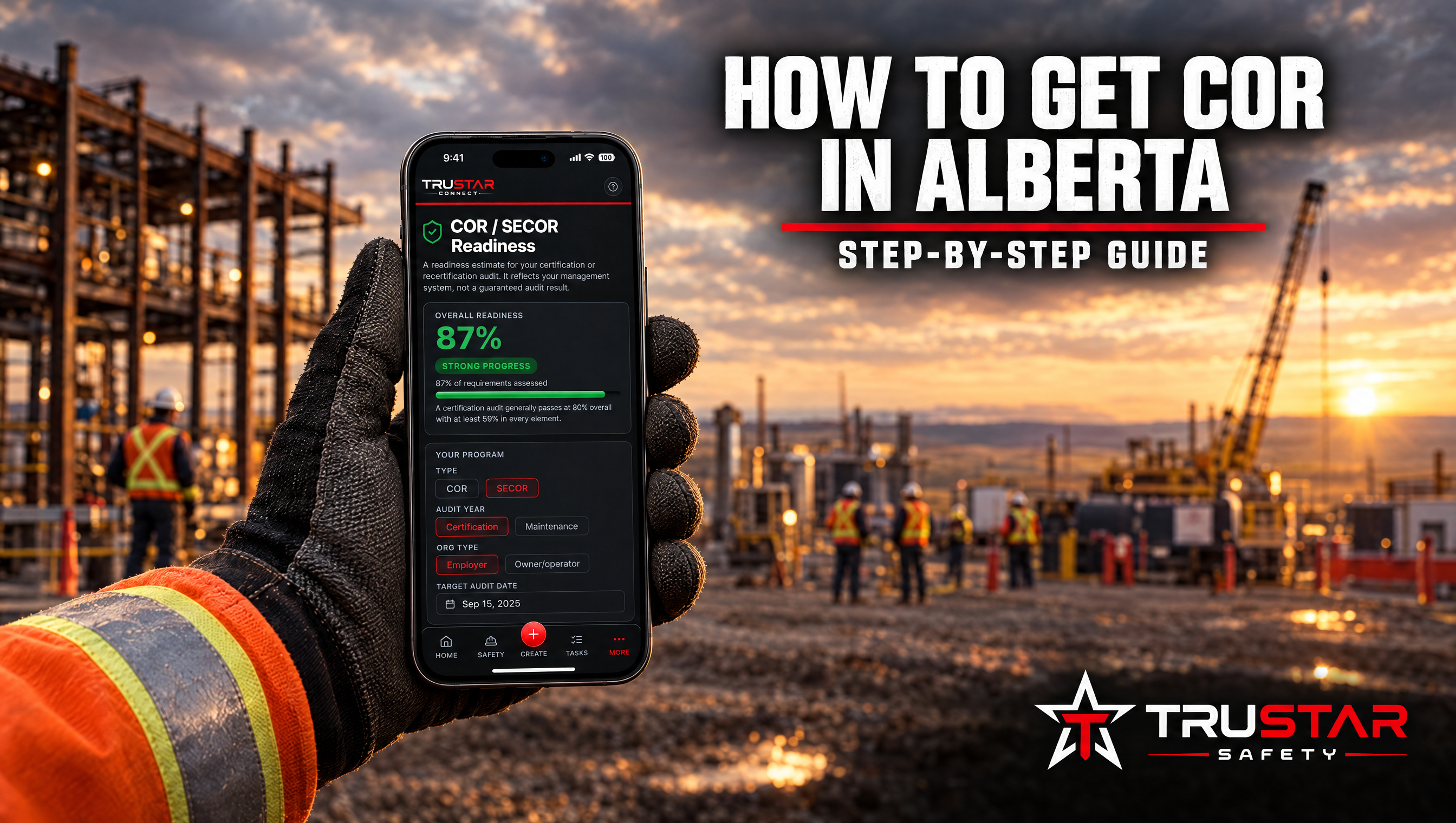
The evidence is where audits are won or lost, which is why we built TruStar Connect. Hazard assessments, inspections, training, investigations and corrective actions live in one place your crews use from their phones. Its COR / SECOR Readiness screen gives a readiness estimate for your certification or recertification audit against the 80% overall and 50% per element benchmark, set to your program type, audit year and target audit date. As the app says, it reflects your management system, not a guaranteed audit result. It shows the gaps while there is still time to close them.
Planning a COR audit for this year or next? Contact TruStar Safety and we will map out your path from where you are today to a certificate on the wall.