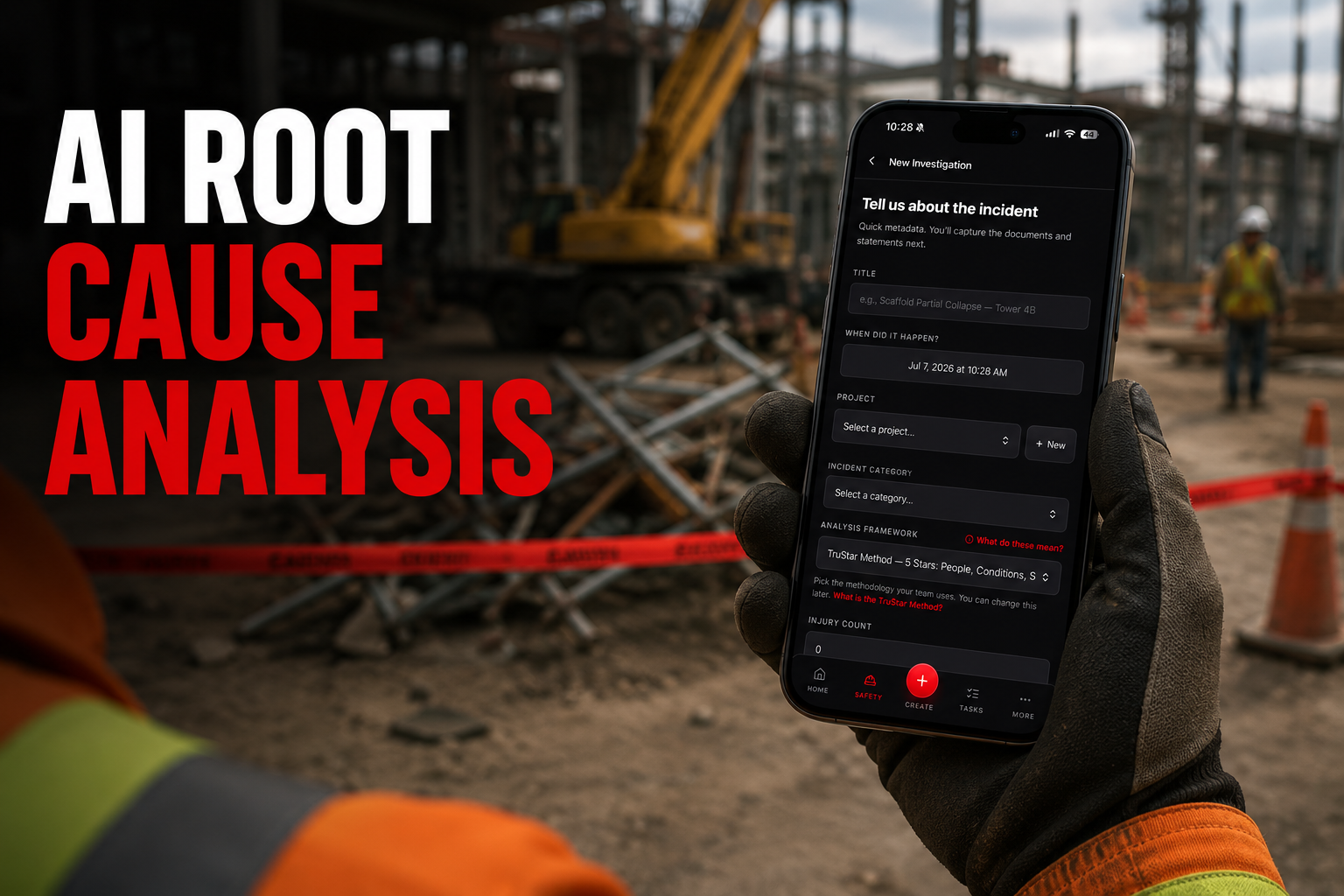
Root cause analysis is one of those tasks every Canadian safety professional knows they should be doing well, and one that legacy tools have quietly made harder than it needs to be. TruStar Connect's AI Root Cause Analysis was built to change that, giving safety teams a faster, smarter way to get to the "why" behind an incident.
The Problem With Legacy RCA
If you have ever run a 5 Whys or a fishbone diagram in a spreadsheet or a static PDF template, you already know the pain points:
- Analysis quality depends heavily on who is in the room and how much time they have.
- Findings are inconsistent from one incident to the next, and from one supervisor to another.
- Corrective actions tend to stop at the first plausible cause (usually "human error") rather than the underlying system failure.
- Trends across sites, crews, and equipment are almost impossible to see without hours of manual data crunching.
- Documentation is often too thin to satisfy a COR/SECOR auditor, a WCB claims reviewer, or a Ministry inspector asking hard questions.
Traditional RCA is not wrong. It is just slow, subjective, and difficult to scale, especially for busy construction, oil and gas, and industrial employers running multiple sites.
What TruStar Connect's AI RCA Actually Does
TruStar Connect's AI Root Cause Analysis is built into the incident management workflow inside the TruStar Connect platform. Instead of handing your team a blank template, it uses the information already captured in your investigation (what happened, where, when, who was involved, contributing conditions, photos, and witness statements) and works alongside your investigator to surface likely root causes.
At a high level, the AI helps you:
- Analyze incident details and identify probable direct, indirect, and root causes.
- Suggest contributing factors you might otherwise miss, including systemic and management-system issues.
- Recommend targeted corrective and preventive actions tied to those causes.
- Produce clean, structured, audit-ready documentation in a fraction of the usual time.
- Spot patterns across incidents so leadership can act on trends, not just one-off events.
The investigator is still in charge. The AI does the heavy analytical lifting and the writing, while your team validates, edits, and signs off. That combination (human judgement plus AI speed) is where the real value lives.
Why It Leaves Legacy RCA Tools Behind
A few things separate TruStar Connect's approach from the static templates and checkbox tools most companies are still using.
It is consistent. Every investigation follows the same rigorous logic, whether it is run by a seasoned HSE manager or a first-time supervisor on a night shift. That consistency is exactly what auditors and regulators want to see.
It goes past "human error." Legacy RCA often stops at the worker. AI-assisted analysis is designed to keep asking why, pushing investigators toward supervision, training, procedures, equipment, and management-system factors that a rushed 5 Whys can easily skip.
It saves real time. Investigations that used to take hours of writing and formatting can be drafted in minutes, freeing your safety team to actually implement corrective actions instead of documenting them.
It scales across sites. Because every RCA is captured as structured data inside TruStar Connect, you can see trends across projects, crews, contractors, and equipment types. That is where leading indicators start to appear.
It strengthens your documentation. Clear cause-and-effect logic, defensible corrective actions, and consistent formatting make life easier at COR/SECOR audit time and when a WCB or provincial OHS officer comes calling.
The goal is not to replace the investigator. It is to give every investigator the analytical horsepower of your most experienced safety lead.
Why This Matters Right Now in Canada
The regulatory bar keeps rising. Ontario's new Administrative Monetary Penalty scheme under the OHSA gives the Ministry a faster enforcement path for contraventions, and penalties can be publicly named. Federal amendments are tightening requirements around emerging hazards like nanomaterials, thermal stress, non-solar UV, and radon, with proposed noise exposure rules on the way. Ontario's updated JHSC certification training now puts more weight on occupational illness, workplace violence and harassment, and mental health.
Every one of those changes increases the value of high-quality investigations and clean, defensible records. If your RCA process cannot keep up, your exposure grows.
Where AI RCA Fits Into Your Safety Program
You do not have to rebuild your program to benefit. AI Root Cause Analysis is most useful when it plugs into what you already do:
- Incident and near-miss investigations: Faster, deeper analysis on every event, not just the serious ones.
- Corrective action tracking: Recommendations flow directly into assignable actions with owners and due dates.
- Trend analysis and leadership reporting: Aggregated causes across sites feed dashboards and monthly HSE reviews.
- Audit preparation: Structured, consistent records support COR/SECOR, ISO, and client prequalification requirements.
- JHSC and safety committee reviews: Better inputs make committee meetings more strategic and less reactive.
Try It Yourself, Free for 14 Days
The best way to understand what AI Root Cause Analysis can do for your team is to run a real incident through it. TruStar Connect offers a 14-day free trial with no obligation, so you can test the workflow on your own data before you commit.
- Learn more about the feature: AI Root Cause Analysis
- Start your free trial: connect.trustarsafety.com
If you would like a walkthrough tailored to your industry (construction, oil and gas, or industrial), or help planning a rollout across multiple sites and contractors, TruStar Safety can help. We will show you exactly how AI RCA fits your program, and how to get value out of it in your first week.