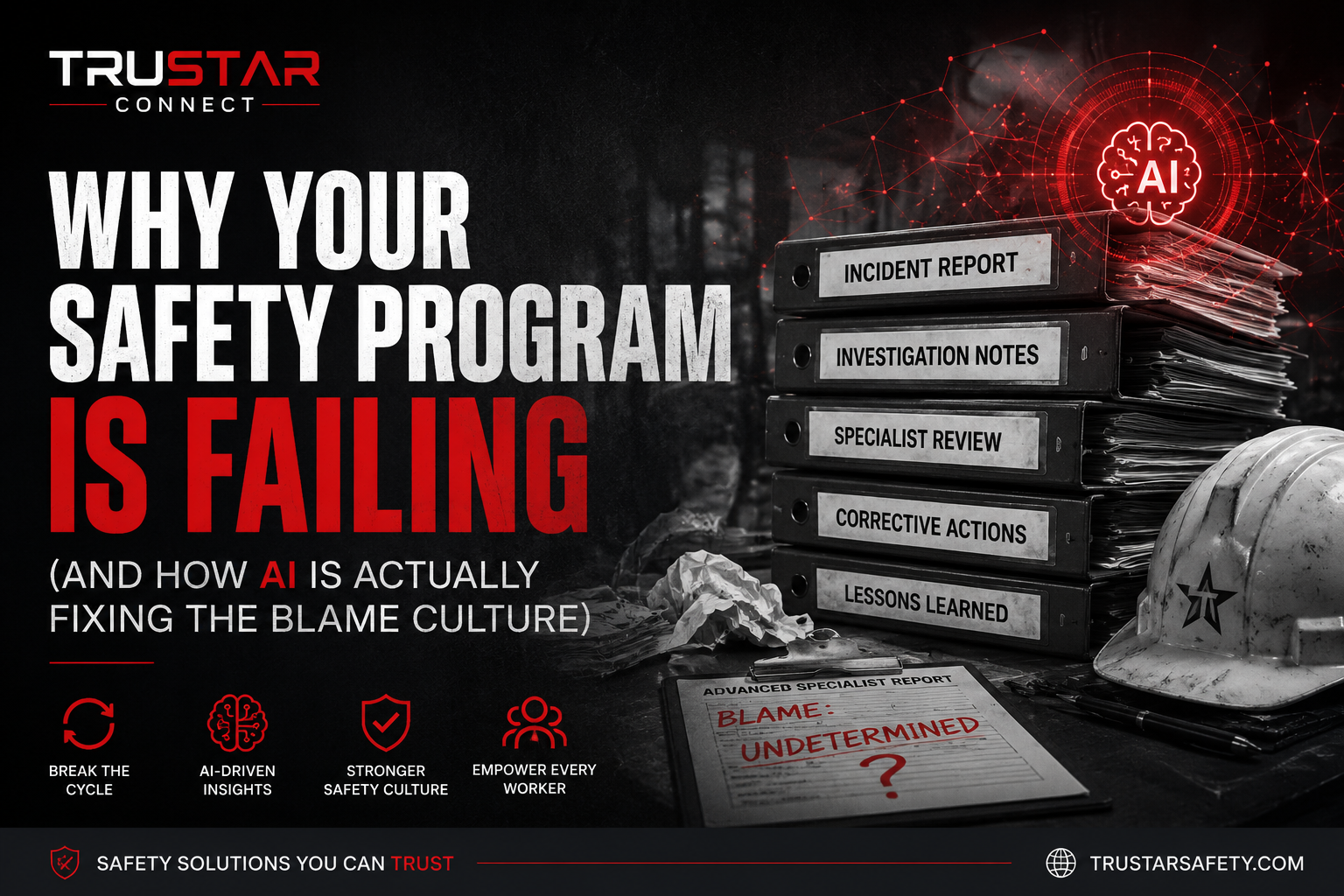
For decades, industrial organizations have remained trapped in a cycle of surface-level fixes. We’ve all seen the ritual: a high-stakes incident occurs, an overextended specialist is dispatched to site, and weeks later, a report is filed away in a binder on a shelf. This "specialist-only" model relies on manual transcription, timelines rebuilt from fading memories, and expensive certifications that keep the tools of investigation out of the hands of the people who actually do the work.
The result is a predictable and frustrating stagnation. Because legacy systems prioritize administrative completion over systemic discovery, the conclusion is almost always the same: "retrain the worker." We know that telling a competent person to "be more careful" rarely prevents the next event, yet without better tools, we continue to hunt for culprits instead of cures.
TruStar Connect and the AI-driven TruStar Method are fundamentally disrupting these assumptions. By democratizing the investigation process and using AI to bridge the gap between policy and reality, technology is finally moving safety from a specialist's paperwork exercise to a site-wide culture of honest answers.
Star 1: Why "Common Sense" is a Myth in High-Risk Work
The TruStar Method begins by dismantling the most dangerous assumption in safety: the myth of "common sense." In a high-risk environment, a reasonable, competent person does what makes sense to them in the moment based on the tools, information, and pressures they face. While traditional Root Cause Analysis (RCA) often treats human error as the end of the road, the modern framework views it as the starting line.
By moving away from specialist-only workflows that require multi-day certification courses, the TruStar Method empowers any competent supervisor to lead a defensible investigation. This shift democratizes safety intelligence, allowing the team to focus on the context of a decision rather than judging it with the benefit of hindsight. We no longer ask who failed; we ask why the system failed to support them.
"The person closest to the incident is almost never the whole story."
The Organizational Signal: What Leadership Actually Tells the Crew
The most radical shift in this methodology is the inclusion of Star 4: Leadership. In legacy investigations, organizational factors are frequently treated as "out of scope," causing the analysis to stop at the front-line worker. This creates a blind spot where systemic failures—such as schedule pressure, inadequate resourcing, and how past concerns were received—are allowed to persist.
In the TruStar Method, Star 4 is weighed equally with Star 2 (Conditions), Star 3 (Systems), and Star 5 (Defenses). Leadership sends "organizational signals" that define the true environment of the jobsite. When these signals prioritize production speed over the layered protections of the Swiss cheese model, the resulting incident is a leadership failure, not a worker error. Integrating leadership into the RCA process forces the executive team to see how their strategic signals manifest as tactical risks in the field.
The Danger of Choosing a Category Too Early
Organizations often fall into a "framing trap" by forcing investigators to select a causal category or framework before the evidence is even collected. This bias-by-design leads to foregone conclusions. The TruStar "Evidence First" workflow reverses this, acting as a bridge between Work as Planned (Reference Documents) and Work as Done (Evidence Documents).
The AI extracts facts from documents before any causal hypothesis is offered, specifically looking for the gaps where real causes live. To ensure the record is defensible for clients, regulators, or auditors, the system requires three distinct evidence types:
By surfacing the friction between what the binder says and what the crew did, the AI identifies the systemic gaps that lead to disaster.
The Human Checkpoint: Why You Still Own the Conclusion
Contrary to the "autopilot" fears surrounding new technology, the AI in this system acts as a rigorous auditor, not a replacement for human judgment. In the TruStar system, a mandatory human checkpoint requires a team member to manually confirm every single extracted fact before it can be used downstream. The AI handles the mechanical labor of classification and timeline building, but the human team owns the conclusions.
To build further authority, the system performs an independent AI bias audit on every analysis. This pass specifically scrutinizes the report for hindsight bias, individual blame framing, and premature closure—the three psychological failures that most often derail legacy investigations. The investigator must review this audit assessment before the report can be finalized and sealed.
"The AI accelerates the work. Your team owns the conclusions."
COR Readiness is Worth Real Money
For Canadian employers, a safety program is a financial asset. Incident investigation is a heavily scored element within the Alberta ACSA COR framework, where companies must hit an 80% overall passing bar and at least 50% in every individual element. A valid COR or SECOR certification is what protects a company’s WCB premium rebate; failing an audit is a direct hit to the bottom line.
TruStar Connect moves safety records from the "last-minute audit folder" panic to a state of live readiness. The "Live Readiness Estimate" module provides a real-time score against audit standards, while the "Today's Paperwork" feature automatically groups forms, permits, and toolbox talks by day and project. This creates a live paper trail that builds itself as work happens. On audit day, there is no scramble—the evidence is already organized, numbered, and ready to defend the rebate.
Beyond the Paperwork: Forcing Stronger Corrective Actions
An investigation is useless if it doesn't force a change in the environment. TruStar Connect uses the Hierarchy of Controls as its ultimate filter for corrective actions. The system is designed to fix the blame culture by deliberately deprioritizing weak fixes like retraining or adding more PPE.
Instead, the platform prompts for "strong" controls: elimination, substitution, and engineering. To ensure these fixes aren't just temporary paperwork exercises, the system implements a mandatory Effectiveness Review. Managers are prompted to verify the fix at 30, 60, and 90 days, proving that the corrective action actually held and the hazard was managed.
Conclusion: A Shift in Perspective
Technology is finally enabling safety leaders to spend less time digging through binders and more time protecting their crews. By using AI to handle document classification and bias auditing, organizations can democratize the investigation process, moving it off the specialist’s desk and into the hands of the supervisors who lead the work.
This transition represents more than a software upgrade; it is an organizational commitment to the truth. As you evaluate your current safety culture, the strategic question is no longer about which form to use, but about intent:
Is your current investigation process designed to find a culprit, or is it designed to find a cure?