A competent worker under Alberta OHS law is someone who is adequately qualified, suitably trained and has enough experience to do the work safely with little or no supervision. If a task could endanger a worker, the employer must make sure it is done by a competent worker or under the direct supervision of one, and you need records that prove it.
That second part is where many contractors get caught. The ticket was real, the worker was capable, but nobody tracked the expiry date, the orientation sign-off went missing, or the "experience" part of competency was never written down. This guide walks through what the law actually says, how to build a training matrix by position, and what proof an auditor or an OHS officer expects to see.
What "competent" means under the Alberta OHS Act
The definition sits in section 1(d) of the Occupational Health and Safety Act. "Competent," in relation to a person, means adequately qualified, suitably trained and with sufficient experience to safely perform work without supervision or with only a minimal degree of supervision.
Read it closely and you will see three separate tests:
- Qualified. The person holds whatever the job requires: a certificate, a trade ticket, an operator qualification, a licence.
- Trained. The person has been trained on the specific hazards, equipment and procedures of this work, at this employer, on this site.
- Experienced. The person has done the work enough times to do it safely with minimal supervision.
A course certificate on its own only answers the first test, and sometimes part of the second. That is why "they have the ticket" is not the same as "they are competent."
Competent worker vs. direct supervision
Section 3(3) of the Act says that if work may endanger a worker, the employer must ensure it is done by a worker who is competent to do the work, or by a worker working under the direct supervision of a competent worker.
In practice, that gives you a legitimate path for new and developing workers. An apprentice or a new hire can do the task while a competent worker directly supervises. What you cannot do is send an unproven worker to do hazardous work alone and hope it goes well. Your records should show which workers are signed off as competent for which tasks, and who is supervising those who are not yet.
Safety training requirements in Alberta: the employer's duty
Section 3(2) of the Act requires every employer to ensure that workers engaged in its work are adequately trained in all matters necessary to perform their work in a healthy and safe manner. Workers, in turn, have a duty under the Act to participate in the training the employer provides.
The general duty is broad on purpose. On top of it, the OHS Code sets out specific training for specific hazards. Fall protection is a good example: section 141 of the OHS Code requires an employer to ensure a worker is trained in the safe use of the fall protection system before the worker works in an area where one must be used, and it lists what that training must cover. Other Code parts carry their own training requirements, so your matrix should be built from the hazards your crews actually face.
Supervisors matter too. The Act requires employers to ensure their workers are supervised by a person who is competent and familiar with the OHS legislation that applies to the work. Alberta's obligations of work site parties page summarizes these duties for employers, supervisors and workers.
Worker orientation: where competency starts
Orientation is the first training record every worker should have. A solid site or company orientation typically covers:
- Worker rights: to know, to participate, and to refuse dangerous work
- The hazards of the work site and the controls in place
- Hazard assessment and how the crew does field level hazard assessments
- Emergency response: muster points, first aid, who to call
- Reporting incidents, near misses and concerns
- PPE required on this site and how to use and inspect it
- Who the supervisor is and who the competent workers are for each task
The orientation should be signed and dated by the worker and the person delivering it. An unsigned slide deck proves that a presentation exists. It does not prove that this worker received it.
How to build a training matrix template by position
A training matrix is a grid: people down one side, required training across the top, and a status in every cell. Built well, it answers the question every auditor and officer asks: "Show me that this worker was trained and competent for this task on this date."
Step 1: List positions, not people
Start with roles: labourer, equipment operator, foreperson, site supervisor, apprentice, office staff who visit site. People change; positions are more stable, and a new hire inherits the requirements of the role.
Step 2: Pull requirements from your hazard assessments
For each position, go through your formal hazard assessments and list the training each hazard requires. Include:
- Legal requirements from the OHS Act, Regulation and Code (for example, fall protection training for anyone who works where fall protection is required)
- Client and prime contractor requirements
- Company requirements: orientation, your safe work procedures, equipment-specific training
- Competency verifications: a practical sign-off by a competent person that the worker can actually do the task
Step 3: Set expiry and refresher intervals
Some certificates carry an expiry set by the training provider or the client. For others, set your own refresher interval and write it into your program so it is applied consistently. Record the completion date and the expiry date for every item, not just a checkmark.
Step 4: Add people and fill the grid
Enter every worker under their position. Each cell should show one of a few clear states: current, expiring soon, expired, or not yet completed. Colour coding makes the gaps obvious at a glance.
Step 5: Assign an owner and a review cycle
A matrix nobody reviews goes stale in weeks. Name a person responsible for it, review it on a set schedule, and check it before mobilizing a crew to a new job. Expiring training should trigger action before the date passes, not after.
Step 6: Link the evidence
Every "current" status should point to proof: the certificate, the sign-in sheet, the practical evaluation. A matrix without evidence behind it is a claim, not a record.
Training records for a COR audit: what auditors expect
To earn a Certificate of Recognition (COR) in Alberta, your audit must score at least 80% overall with a minimum of 50% in each audit element. Each Certifying Partner develops its own audit instrument, so check the exact questions in yours. In general, auditors verify your training and competency system through documents, observations and interviews, and those three need to tell the same story.
Documentation an auditor will ask for
- A training needs list or matrix by position, tied to your hazard assessments
- Orientation records, signed and dated, for workers on the sample list
- Certificates and tickets, current on the dates the work was done
- Competency verifications: who assessed the worker, on what task, when
- Supervisor training records, including OHS legislation awareness
- Evidence that expired or missing training was caught and corrected
Interviews and observations
Expect the auditor to ask workers what they were shown in orientation, what training they have had, and who they go to when they are unsure. Supervisors will be asked how they know a worker is competent for a task. If the paperwork says one thing and the crew says another, the paperwork loses.
What an OHS officer expects after an incident
After a serious incident, an officer may look at whether the worker was trained and competent for the task, and whether the employer can show it. The questions are simple. Was this worker trained for this work? When? By whom? Was the training current? Was a competent worker supervising? Records created after the fact do not help anyone, so keep them current as you go.
Common training record gaps to fix now
- Expired tickets nobody tracked. Especially first aid and equipment certifications that lapse between jobs.
- Orientation without signatures. Or signed by the worker but not the presenter, with no date.
- "Experienced" with no evidence. Competency assumed from years in the trade, never verified on your equipment and procedures.
- Subcontractor workers missing. Prime contractors are often asked how they confirm the competency of other employers' workers on site.
- Records scattered. Some in a binder in the truck, some in an inbox, some in the supervisor's head.
Frequently asked questions
What is a competent worker in Alberta?
Under section 1(d) of the Alberta OHS Act, a competent person is adequately qualified, suitably trained and has sufficient experience to safely perform the work without supervision or with only minimal supervision. All three parts need to be true for the specific task.
Is a safety ticket enough to prove competency?
No. A ticket shows the person completed a course. Competency also requires training on your specific hazards, equipment and procedures, and enough experience to do the work safely. A practical sign-off by a competent person is the usual way to document that.
Can a worker who is not yet competent do hazardous work?
Yes, but only under the direct supervision of a worker who is competent to do that work, as set out in section 3(3) of the OHS Act. Record who supervised and when.
How long should I keep training records?
Keep them for as long as your safety program, your clients and your COR Certifying Partner require, and long enough to show a worker was trained on the date any work was done. Set a retention period in your program and apply it consistently.
What is the difference between orientation and training?
Orientation introduces a worker to your company or site: rights, hazards, emergency procedures and who to go to. Training builds the specific knowledge and skills for tasks. Both need records.
How TruStar can help
TruStar Safety helps Alberta employers turn the legal duty into a system that works in the field. We build competency frameworks and training matrices by position, write and deliver worker and site orientation programs, deliver safety training, and prepare companies for COR and SECOR audits so training records hold up to documentation review, interviews and observations. If you need ongoing support, our fractional safety managers can own the matrix for you. Talk to our team.
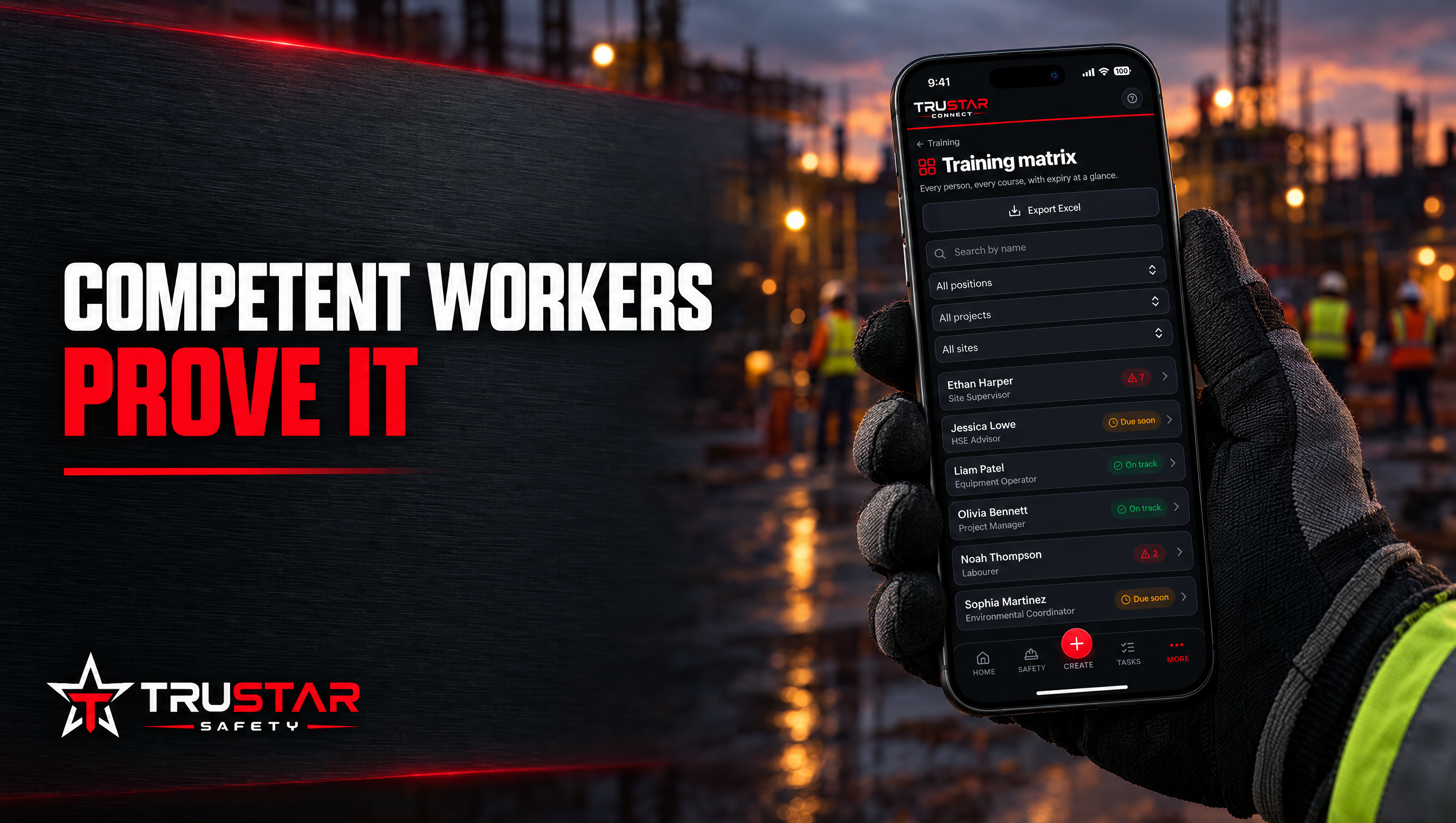
If you want the records handled day to day, TruStar Connect includes a Training Matrix that shows every person, every course and every expiry at a glance, with an Excel export for your auditor or client. Start a free trial and see where your gaps are before an auditor does.