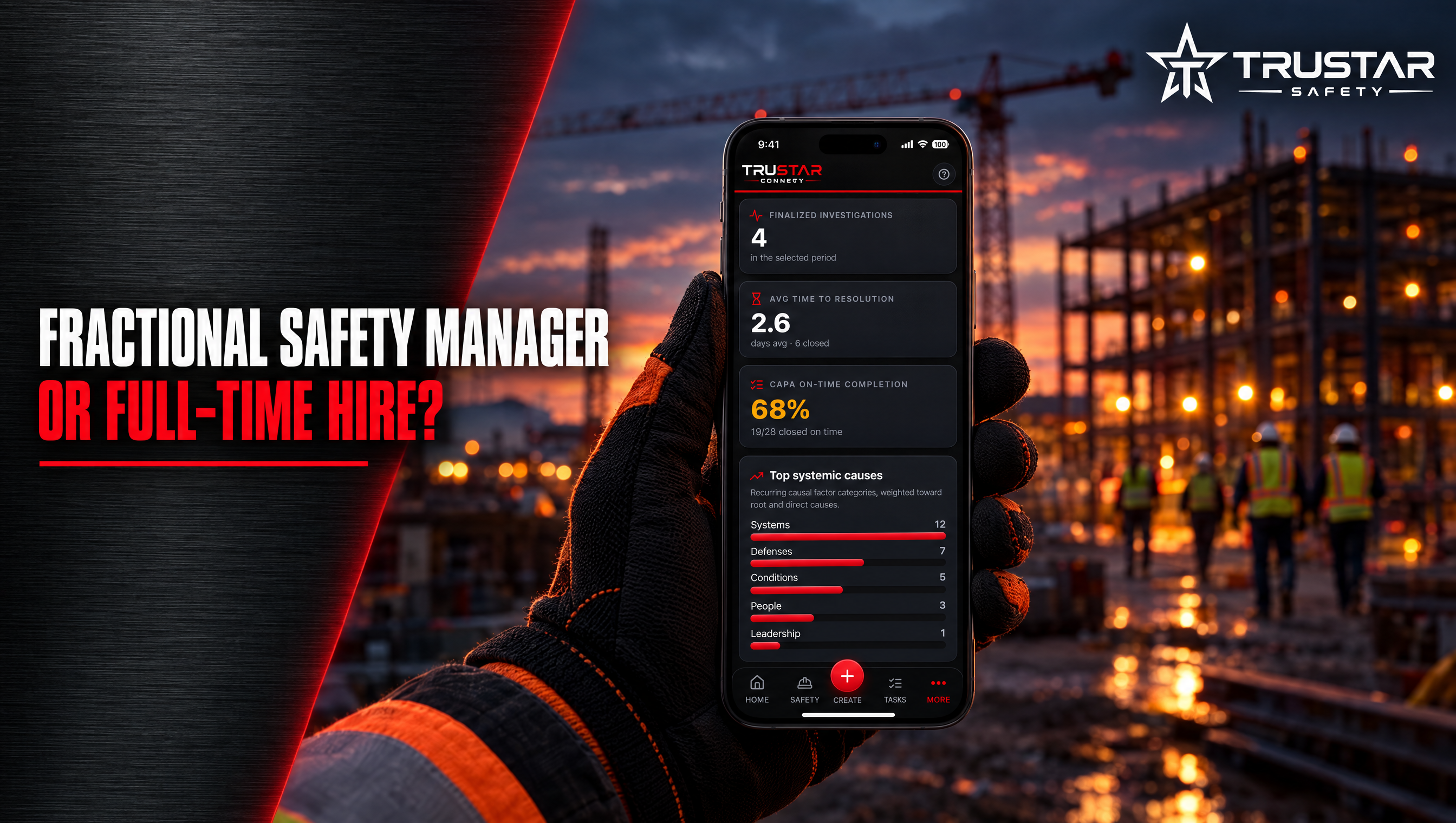
A fractional safety manager is a senior safety professional who works for your company part-time, on a set schedule, and leads your safety program without being a full-time employee. For many growing Alberta contractors, it is the practical middle ground between the owner doing safety at night and hiring a full-time safety manager before the work can carry one.
This guide covers when a growing contractor outgrows the owner-does-safety model, what a fractional safety manager actually does month to month, how the cost trade-offs compare with a full-time hire, and how to tell whether it fits your company.
What is a fractional safety manager?
The idea comes from the fractional CFO: you get senior experience for the hours your business needs, not a salary for hours it does not. A fractional safety manager (you will also see "outsourced safety manager" or "part-time safety coordinator") becomes part of your leadership team on a retainer. They own the safety program, visit sites, coach supervisors, lead investigations and keep your COR or SECOR on track.
It is different from calling a safety consultant once a year. A one-off consultant writes a manual or runs an audit and leaves. A fractional manager stays, knows your crews and your jobs, and is accountable for results over time.
What a fractional manager does not change
Hiring help does not move your legal duties. Under section 3 of Alberta's Occupational Health and Safety Act, every employer must ensure, as far as reasonably practicable, the health, safety and welfare of its workers, that workers are adequately trained, that dangerous work is done by or under the direct supervision of a competent worker, and that workers are supervised by someone competent and familiar with the legislation. Those obligations stay with the employer and its supervisors. A good fractional manager makes it far easier to meet them; they do not take them off your plate.
When a contractor outgrows the owner-does-safety model
Most Alberta contractors start the same way: the owner knows the work, knows the crew, and handles safety personally. That works until the company grows past what one busy person can keep up with. These are the usual signs.
Your headcount crosses a legal line
Alberta's OHS Act ties several requirements to the number of workers you regularly employ:
- 5 to 19 workers: section 14 requires you to designate a health and safety representative, a worker not associated with management.
- 20 or more workers: section 13 requires a joint health and safety committee, and section 16 requires you to establish and implement a health and safety program (OHS Act, Part 2).
Alberta counts workers across all of your work sites toward the 20, and employers under 20 still need documentation that meets the legislation, including hazard assessment and control and an emergency response plan (Alberta.ca, Health and safety program).
You move from SECOR to COR
SECOR is built for small employers. Alberta's certifying partners limit it to companies with 10 or fewer employees, and everyone on your WCB-Alberta account counts, including owners and office staff (ACSA, COR and SECOR). Grow past that and you are into full COR, with an external audit and a program that has to be working in the field, not just on paper.
Clients start asking harder questions
Prequalification platforms, prime contractors and owners want COR, current statistics, written procedures and proof of training. If answering a prequalification questionnaire takes the owner a full weekend, the system is carrying more than one person can hold.
The paperwork is there but nobody is reading it
Hazard assessments get filled in and filed. Inspections happen, but corrective actions sit open. Toolbox talks are signed and forgotten. Nothing is wrong on paper, yet nobody has time to look for the patterns that come before an incident.
Something went wrong
An incident, an OHS order or an audit that did not pass is often the moment an owner realises safety needs a dedicated leader. It is better to act before that point.
What a fractional safety manager does month to month
Every engagement is scoped to the company, but a typical month looks something like this.
- Site visits on a schedule. Planned visits to active jobs to inspect, observe work, talk with crews and check that hazard assessments match what is actually happening.
- Supervisor coaching. Foremen and supervisors carry the program day to day. The fractional manager helps them run better toolbox talks, lead hazard assessments and handle a worker who pushes back.
- Program ownership. Keeping policies, safe work procedures and the emergency response plan current as the work changes, and making sure the joint health and safety committee or health and safety representative is doing its job.
- Incident response and investigation. Available when something happens, leading or guiding the investigation and making sure corrective actions actually close.
- COR and SECOR readiness. Tracking the evidence auditors will ask for all year, so the audit is a check of a working system rather than a scramble.
- Training oversight. Knowing who is trained, who is due, and who is not yet competent for the task they are about to do.
- A regular report to leadership. A short summary for the owner: what was found, what is open, what the trends say and what needs a decision.
The part most people miss is what happens between visits. A fractional manager who is on site a few days a month needs to see what the crew is doing the rest of the time. That is where the system matters.
Fractional safety manager vs full-time hire: the cost trade-offs
Salary figures vary widely with experience, sector and region, so rather than quote a number, compare what you are really buying.
What a full-time hire gives you
- One person devoted to your company every working day.
- Deep knowledge of your crews and jobs over time.
- Presence on site whenever needed.
What a full-time hire costs beyond the salary
- Benefits, a vehicle, equipment, training and certifications.
- Recruiting time, and the risk of a poor fit in a small company.
- A single point of failure: when they leave or take holidays, the program stalls.
- Often, a less experienced hire than you wanted, because a senior person costs more than a small company can justify.
What a fractional arrangement gives you
- Senior experience for the hours your company needs, scaled up for a big project or an audit and down in a slow season.
- A predictable monthly cost instead of payroll, benefits and overhead.
- Backup from a wider team, so coverage does not stop when one person is away.
- An outside view: someone who has seen many programs and knows what auditors and OHS officers look for.
Where fractional falls short
It is not the right answer for everyone. If you run large crews on several sites every day, have high-risk work that needs a safety professional on site full-time, or a client contract requires a dedicated site safety person, you need full-time coverage. Many companies use a fractional manager to build the program and the case for a full-time hire, then keep them on to mentor the new person.
Is safety software for contractors enough on its own?
Some consultants argue that a safety app is no substitute for a safety leader. They are right that software does not walk a site, coach a foreman or notice that a crew is cutting corners. But the opposite is also true: a part-time leader with no daily system is working blind for most of the month.
The strongest setup is both, from one provider:
- Senior part-time leadership that sets direction, coaches supervisors and owns the program.
- A system the crew uses every day so hazard assessments, inspections, observations and corrective actions are captured in the field and visible right away.
With TruStar Connect, the fractional manager checks the Dashboard for what is open across sites, uses Analytics to spot trends in hazards and observations before they turn into incidents, and assigns follow-ups that land in each person's My Tasks so they get closed rather than forgotten. The site visit then becomes time spent on the problems the data has already surfaced.
How to judge whether a fractional safety manager fits your company
Use this checklist before you decide.
- Your crew is growing past what the owner can manage alone, or you are approaching the 20-worker threshold.
- The owner or a project manager is carrying safety on top of a full job.
- You need to achieve or maintain COR or SECOR.
- Clients or prime contractors are asking for more safety documentation.
- Hazard assessments and inspections happen, but trends and corrective actions are not followed up.
- You cannot yet justify, or find, an experienced full-time safety manager.
If most of those are true, a fractional arrangement is worth a serious look.
Questions to ask a fractional provider
- What credentials and Alberta field experience does the person leading my account have?
- How many site visits a month are included, and how are extra hours handled?
- Who covers when my manager is away?
- How will you see what happens on site between visits?
- What will you report to me, and how often?
- How do you support COR or SECOR audits?
- What does the engagement cost, and how does it scale as we grow?
Frequently asked questions
What does a fractional safety manager do?
A fractional safety manager leads your safety program part-time: scheduled site visits, supervisor coaching, program updates, incident investigations, training oversight, COR or SECOR readiness and regular reporting to leadership.
Is a fractional safety manager cheaper than hiring full-time?
For most small and mid-sized contractors, it costs less, because you pay for the hours you need instead of a full salary, benefits and overhead. The right comparison is the level of experience you get for the money, and whether your work actually needs someone on site every day.
Do Alberta employers legally need a safety manager?
The OHS Act does not require a specific job title. It requires employers to meet their duties under section 3, designate a health and safety representative at 5 to 19 workers, and have a joint health and safety committee and a health and safety program at 20 or more. How you staff that is your decision.
Can a fractional safety manager help us get COR?
Yes. Building the program, training supervisors, collecting evidence and preparing for the audit are core parts of the work. Keeping COR is ongoing, so continuous support matters as much as the first audit.
Does a fractional safety manager take on our legal liability?
No. The employer and its supervisors keep their obligations under the OHS Act. A fractional manager helps you meet them and gives you the records to show it.
How TruStar can help
TruStar Safety provides fractional safety managers for Alberta contractors: senior, field-practical safety leadership that builds and runs your program, coaches your supervisors and keeps you ready for COR or SECOR. Because we also built TruStar Connect, your fractional manager has eyes on your sites between visits, through the Dashboard, Analytics and My Tasks, and your crew has one simple app for hazard assessments, inspections, observations and corrective actions.
One provider, part-time leadership and a full-time system. Talk to TruStar about a fractional safety manager, or start a free trial of TruStar Connect.